F1
Joseph Kosinski’s big brand riff on Days of Thunder succeeds in its high octane thrills but fails to make pole position
It’s been clear, through his small but successful filmography, that Joseph Kosinski has an affinity for vehicles. Whether it’s through capturing the neon soaked Light Cycles of Tron: Legacy; the slick white vehicles of Oblivion or; most recently, the super sonic pitch of the F/A-18 Super Hornet’s of Top Gun: Maverick, Kosinski’s eye for the movement of vehicles has cemented itself as a go to in the industry of big blockbusters.
With this affinity, and after going to the lengths that were required to capture the incredible flight footage of Maverick with Tom Cruise & Jerry Bruckheimer, it seems only natural that Kosinski’s next step in the blockbuster space was to do his best riff on Days of Thunder using the closest thing to a spaceship on wheels; the Formula One car.
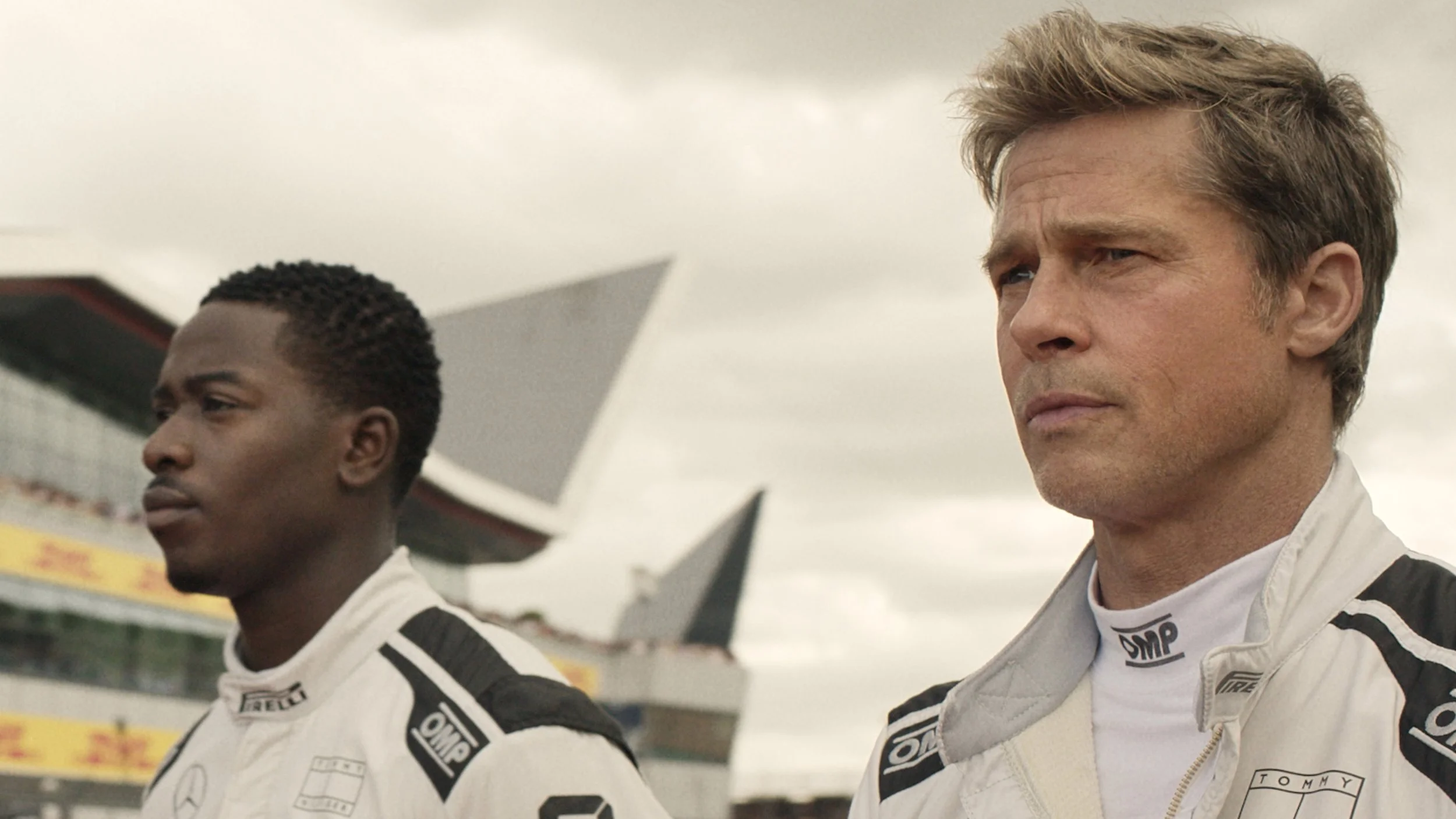
Telling the story of Sonny Hayes (Brad Pitt), an ex-formula one driver who has found means to ends by getting behind the wheel of every type of motorsport he can, F1 is an exhilarating yet familiar tale of competition, mentorship and what success means to the individual.
After being provided a free seat halfway into the F1 season by ex-team mate and old friend Ruben Cervantes (Javier Bardem), Sonny is quickly introduced to his new team. technical director Kate McKenna (Kerry Condon), chief mechanic Dodge (Abdul Salis) and hot shot, number one driver Joshua Pearce (Damson Idris).
Immediately butting heads with his young team mate, Sonny lets his past dictate his present as he begins to torment Joshua (playfully nicknamed JP) by challenging his ego and making race by his rules. The two quickly become rivals on the racetrack, despite being on the same team, as Joshua expects victory while Sonny’s chaotic nature pushes his team mate to the limits.
Naturally, the tumultuous relationship of these characters brings to mind Bruckheimer’s classic Days of Thunder, which has its DNA throughout F1, likely from its ties to its producer and Kosinski’s prior work with Tom Cruise. Idris commits to Joshua’s cocky nature so fully that he is often unlikeable. With his heavy focus on social media, Joshua often discredits his losses to the camera, but is the first to blow up at the team for causing any potential issues. However, Idris’ commitment to this young maverick makes his inevitable redemption all the more rewarding for the audience.
Unfortunately though, Sonny’s relationships through the film are the weakest aspect of F1. Both a shortcoming of the available material in Ehren Kruger’s screenplay, of which Kerry Condon makes the absolute most out of, and also Brad Pitt’s on screen charm cowering in the shadow of Cruise’s, there is something sorely missed off the track here.
Thankfully, the film absolutely sings ON the track. Kosinski, re-teaming with Maverick cinematographer Claudio Miranda, captures these races like audiences have never seen them before. Implementing (what appears to be) the same camera technology used in the cockpits of the Super Hornets, Kosinski and Miranda put audiences behind the wheel of these vehicles as they hit speeds upwards of 300km/h leading into all sorts of twists and turns.
This is where F1 is at its strongest. Even when Sonny and Joshua’s rivalry is feeling thin, or in the aftermath of Sonny’s flirtatious meetings with Condon’s Kate McKenna, the racing is always the star of the show. Despite taking immense liberties with the logic of a regular Formula One race, through Sonny’s reckless antics, it’s with these liberties that the races become far more engaging than they otherwise could have been for a sport that doesn’t always have all that much race action.
While these moments may sour in the mouth of hardcore Formula One fans, they are sure to nail most audiences to their seats with their electric (albeit repetitive) camera work, bone rattling sound design and the pulsating score from Hans Zimmer. All of these elements come together to make for some truly incredible sequences. It’s outside of those moments, however, where the film's near 3-hour run time can be felt.
In the looming shadow of the immensely successful Netflix series Drive to Survive, F1 tries to make real some of the manufactured drama that series created to really draw in unfamiliar audiences to the sport. Not only on the track, with over the top pit stops and vehicle flipping collisions, but also in the team room with mechanics and team investors going head to head in an attempt to win (or lose) races.
These dramatic beats unfortunately fall flat most of the time, which can drown out a lot of the character tensions within the film. While this ultimately isn’t detrimental to the final product, it does take away from what could have otherwise been a really tight film about racing. Similarly, Sonny and Kate’s romance often feels inorganic and rule breaking a lot of the time, despite the pair's commitment to the material. While Condon brings a playful wit to the film’s often silly dialogue, Pitt’s performance is rooted in his charisma; something that has caused many of his late career performances to feel interchangeable.
It is surprising, then, that there is still enough in F1 to keep audiences engaged and excited through its lengthy runtime. Joseph Kosinski mightn’t be making the most thought provoking blockbusters amongst his cohort, but he is doing something that a lot of these big budget films haven’t done for some time and that is capture spectacle. Even over all the bumps along the track and despite its lacklustre and familiar dramatic beats, F1 brings enough high octane thrills and impressive filmmaking to make for a good time at the movies. Even if it doesn’t quite make it onto the podium.
F1 is in Australian cinemas now!